SENIOR DRIVER SAFETY
Leaving an Angle Park Safely
Reversing out of a 90-degree parking bay can be demanding when nearby vehicles restrict the view. For an older driver, the safest approach is not to rush: check all around, reverse very slowly, keep the eyes moving and stop whenever the view or situation is uncertain.
What the South Australian standard expects
The South Australian Driving Companion requires a driver leaving a 90-degree angle park to check behind over both shoulders, to both sides and to the front before moving and throughout the reverse. The vehicle should move slowly under full control, reverse only as far as necessary, clear the adjacent bay safely and then move off using the normal observation sequence.
Plain-language rule: check before moving, continue checking while moving, and stop if you cannot confirm the path is clear.
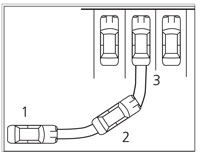
A calm observation-first sequence
1. Prepare without moving
Keep the foot brake applied, select reverse, sit comfortably and make sure mirrors give a useful view. Do not let the car creep while attention is still on the controls.
2. Check the whole area
Look behind over both shoulders, along both sides and toward the front corners. Check for pedestrians, mobility scooters, children, shopping trolleys, cyclists and vehicles moving or reversing in the aisle.
3. Reverse very slowly
Release the brake only when the path is clear. Reverse at a speed that allows an immediate stop. Keep looking behind, to the sides and back to the front rather than holding the eyes on one mirror or the camera.
4. Protect the front corners
As steering is added, the front of the car swings toward the vehicle or object beside the bay. Confirm clearance before turning more. Reverse only far enough to clear safely, then counter-steer as needed.
5. Stop and reset
Stop before selecting Drive or first gear. Recheck mirrors, the intended direction and relevant blind spots. Signal where appropriate and move forward smoothly only after the aisle is clear.
Stop whenever unsure
A waiting driver is not a reason to hurry. If someone enters the area, a warning sounds, the view is blocked or the car’s position becomes uncertain, stop and reassess.
Helpful adjustments for older drivers
- Choose a quieter, well-lit part of the car park and a wider bay where possible.
- Avoid parking beside a van, large SUV or other object that blocks the view into the aisle.
- Set the seat and mirrors before the trip so turning the head and upper body is as comfortable as possible.
- Use a reverse camera and sensors as extra information, not as a substitute for direct observation.
- If glare, fatigue, pain or stiffness makes observation difficult, pause the trip or ask another suitable driver to take over.
Common unsafe habits
- Checking once, then reversing without continuing to scan.
- Watching only the reverse camera or only the centre mirror.
- Turning sharply before the front corner has cleared the neighbouring vehicle.
- Reversing farther than necessary.
- Changing to Drive and moving immediately without a fresh observation check.
- Continuing because another driver is waiting or sounding a horn.
Practise in stages
- While parked and secured, rehearse the head, shoulder and mirror checks without moving.
- Practise low-speed control and stopping promptly in a quiet, open area with a suitable supervisor or driving professional.
- Use a quiet marked car park before attempting a busier shopping-centre environment.
- Finish each attempt by discussing what was visible, what was blocked and where an earlier stop would have helped.
Do not place a helper behind or beside a moving vehicle. Any observer should remain in a safe location and the driver remains responsible for confirming the path is clear.
When movement or vision makes checking difficult
Neck or shoulder stiffness, pain, reduced vision, medication effects and fatigue can make reversing observation harder. A GP or other treating health professional can discuss health concerns. An occupational therapy driving assessment may be appropriate when functional driving ability needs individual assessment.
South Australian drivers must report a medical condition that may affect their ability to drive safely. Use current SA Government information for fitness-to-drive requirements.
SA.GOV.AU: Medical conditions and fitness to drive
My Licence: The Driving Companion, Unit 2 Task 12
General educational information only. Road rules, licence conditions and medical requirements can change. Review date: 14 August 2026.