For senior overseas drivers undertaking licence conversion or reassessment
For senior overseas drivers learning to drive in South Australia—or undertaking a licence conversion, reassessment, or refresher driving test—the Vehicle On Road Test (VORT) is a vital step in obtaining or retaining a South Australian driver’s licence.
The VORT is a detailed driving assessment that measures how well a driver understands and applies South Australian road rules in real traffic conditions. Central to this assessment is the VORT marking sheet, which is a detailed record of driving performance throughout the test.
The Starting Point
The VORT begins at a government-determined location and follows a preset route.
Its start time is pre-booked by the examiner via the DPTI (now DIT) computer system and cannot commence earlier, as tests may be subject to audit.
If auditors are present, they sit immediately behind the driver’s seat, observing the examiner’s conduct, not the driver’s performance. This applies equally to senior drivers, including those completing tests as part of overseas licence conversion or medical review processes.
The Vehicle Check
Before the test begins, the examiner conducts a brief vehicle check. This includes confirming:
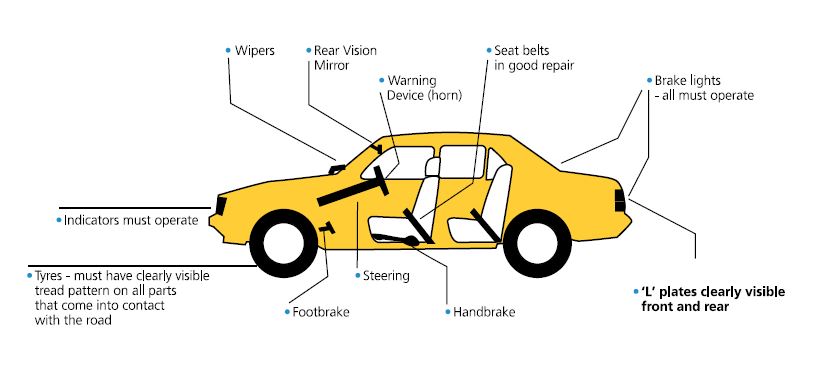
- Indicators are working
- Brakes are functional
- Tyres have adequate tread
The examiner ensures the vehicle is legal and safe for the test, regardless of the driver’s experience or years of driving overseas.
The VORT Recording Sheet
The VORT recording sheet is used by the examiner to document the test process and outcome.
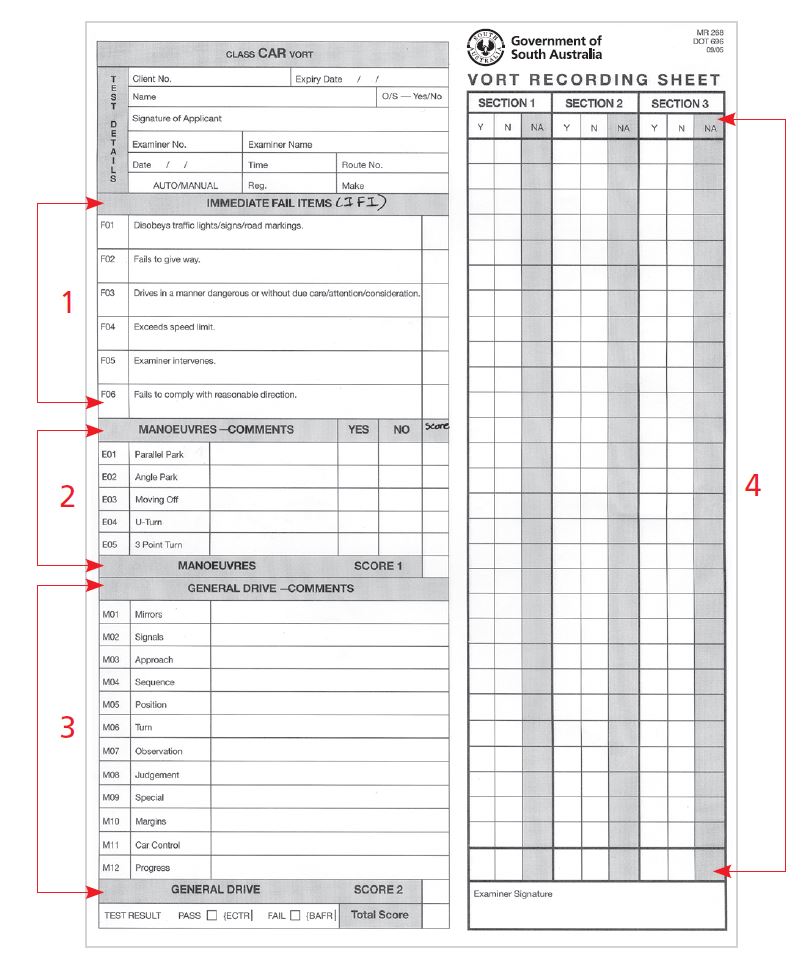
It records details including:
- Driver and examiner information
- Test timing and route
- Vehicle details
The sheet is divided into sections, each with a specific purpose.
Immediate Fail Items
This section records situations that result in an immediate fail, regardless of the score accumulated before the incident.
Immediate fail items reflect serious breaches of road rules or unsafe driving behaviour and will cause the test to end immediately.
For senior overseas drivers, the six most common immediate fail items are:
1. Disobey traffic lights, markings, or signs
This includes failing to obey:
- Traffic lights
- Road markings
- Regulatory signs such as STOP, GIVE WAY, or NO ENTRY
2. Fail to give way
This applies to any situation where the driver:
- Fails to give way when required by South Australian road rules
- Causes another road user to slow down, stop, or change direction
3. Driving without due care
This refers to driving behaviour that:
- Creates risk to people or property
- Shows a lack of reasonable care, attention, or vehicle control
4. Speeding
This includes:
- Exceeding the posted speed limit
- Not adjusting speed appropriately for road, traffic, or weather conditions
5. Examiner intervention
An immediate fail occurs if the examiner:
- Must physically intervene (such as braking or steering), or
- Takes action to prevent an unsafe situation
6. Fail to comply with a reasonable direction
This applies when the driver:
- Does not follow a clear, lawful instruction from the examiner
- Repeatedly ignores or refuses reasonable directions during the test
General Drive Recorder
This section records the general driving component of the test, following the set route directions.
- If all criteria for a step are met, the examiner marks “Yes”
- If any part of the criteria is not met, the examiner records “No”
The examiner uses short marking codes to identify which driving element did not meet the required standard.
Marking Codes
M – Mirrors
- Mirror checks must be done before any manoeuvre, such as turning or slowing
- The centre mirror and an appropriate exterior mirror must be checked
- Mirror checks must occur before signalling
- The mirror check must be within 5 seconds of the signal
S – Signal
- Direction signals must be used correctly and at the appropriate time
- Signals must not mislead other road users
- Signals must be given after the mirror check, not before or at the same time
A – Approach
- Relates to how the driver approaches a turn or hazard
- Speed must be appropriate
- The approach path must suit the situation
Q – Sequence
- Used when mirror checks, signals, or approach actions are performed out of sequence
- Most commonly occurs when signalling before checking mirrors
P – Position
- Assesses whether the driver is positioned correctly on the road
- Includes correct lane position, turning position, and keeping as close to the left as practical on unlaned roads
T – Turn
- Relates to correct execution of turns at intersections
- The driver must stay in lane and enter the correct side of the new road
- Incorrect turns, such as cutting corners or turning wide, may result in an immediate fail
O – Observation
- Does not include mirror checks
- Focuses on blind-spot checks, scanning intersections, and general awareness
J – Judgement
- Assesses the driver’s decision-making ability
- Includes selecting safe gaps and not hesitating unnecessarily
- Poor judgement may result in an immediate fail for not giving way or causing obstruction
Special Situations
Four additional codes are assessed once per test section:
- SPEC – Special situations
- MARG – Collision avoidance space
- PROG – Progress
- V.CON – Vehicle control
These cover unique situations that may arise during the test and contribute to the overall assessment.
Scoring the General Drive
At the end of the test:
- The total number of “No” and “N/A” marks is counted
- This number is subtracted from the total criteria
- The result is converted to a score out of 90
Manoeuvres
Manoeuvres are recorded separately.
- Each successful manoeuvre is worth 2 marks
- Manoeuvres contribute 10 marks in total
- This is added to the general drive score to produce the final result
General Drive Comments
In this section, the examiner explains any criteria marked “No”.
This feedback is particularly useful for senior overseas drivers who may be adjusting long-established driving habits to meet current South Australian standards.
Result
A pass requires:
- A total score of 90 or above
- No immediate fail items
The examiner will calculate the result, provide feedback, and, if successful, issue a Certificate of Competence.
End of the Test
Whether the outcome is a pass or a fail, drivers should listen carefully to the examiner’s comments. The feedback is intended to help drivers drive more safely and confidently under South Australian road rules.
For senior overseas drivers, having an experienced instructor present during feedback can be helpful in understanding how local expectations differ from overseas driving practices.
Disclaimer – Overseas Licence Conversion
Disclaimer (Overseas Licence Conversion):
This article is provided for general information only and is intended to help senior overseas drivers understand how the VORT marking sheet is commonly used in South Australia. Licence conversion requirements, assessment pathways, and test conditions may vary depending on individual circumstances, country of licence issue, visa status, and medical requirements. Drivers should always confirm their specific eligibility and testing requirements directly with the Department for Infrastructure and Transport (DIT).
Disclaimer – Authority of DIT
Disclaimer (Regulatory Authority):
The Department for Infrastructure and Transport (DIT) is the sole authority responsible for driver licensing, testing standards, and assessment outcomes in South Australia. This article does not override, replace, or modify any official DIT policies, procedures, or examiner decisions. In all cases, DIT rules, examiner instructions, and official publications take precedence.
References
- Department for Infrastructure and Transport (DIT) (South Australia).
Driver’s Handbook. Government of South Australia.
Available at: https://www.mylicence.sa.gov.au/road-rules/the-drivers-handbook - Department for Infrastructure and Transport (DIT) (South Australia).
Vehicle On Road Test (VORT) – Information for Licence Applicants. Government of South Australia.
Available at: https://www.sa.gov.au/topics/driving-and-transport/licences/driving-tests - Government of South Australia.
Overseas Licence Holders – Converting to a South Australian Driver’s Licence.
Available at: https://www.sa.gov.au/topics/driving-and-transport/licences/drivers-licence/overseas-drivers - Road Traffic Act 1961 (SA).
Government of South Australia.
Available at: https://www.legislation.sa.gov.au - Australian Road Rules.
National Transport Commission.
Available at: https://www.ntc.gov.au/laws-and-regulations/australian-road-rules